
1. Key messages
- Belgium has been strengthening tobacco control over time, but lacks measures to prevent interference by the tobacco industry.
- In the Global Tobacco Industry Interference Index, Belgium scores better than average: 38th out of 100 countries globally, and 9th out of 25 European countries.
- Nevertheless, incidents of influence have been identified, including indirect contacts and partnerships related to cigarette butt litter.
- Formal measures that ensure transparency and regulate interactions are lacking.
Discover the Belgian report on tobacco industry interference index.
2. Belgium’s Tobacco Control Strengthens, but Industry Interference Remains Insufficiently Addressed
Commitments, but few concrete measures
In recent years, the federal government has taken concrete steps towards a smoke-free society. Belgium ratified the Framework Convention on Tobacco Control of the World Health Organization (WHO FCTC) in 2005 [1], and specific objectives were formulated in the Interfederal Strategy 2022–2028 for a smoke-free generation [2]. This has recently led to the expansion of smoking bans in various public spaces and restrictions on the availability of tobacco and nicotine products. Commitments under WHO FCTC Article 5.3 concerning industry interference were also included in the Interfederal Strategy, such as establishing a transparency register and a code of conduct. However, the development and implementation of these measures appear to have stalled, and there are currently few official measures in place to protect health policy from interference by the tobacco industry.
Belgium scores above average, but shortcomings remain
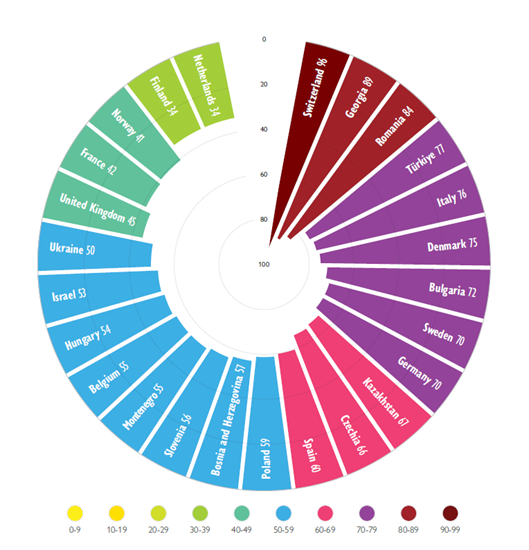
To hold the Belgian government accountable for keeping tobacco industry interests out of policymaking, Belgium participated for the first time in the Global Tobacco Industry Interference Index in 2025 [3]. This international index evaluates, based on publicly available information, the measures governments take to prevent public health policies from industry interference, in line with the guidelines of WHO FCTC Article 5.3. Countries are scored out of a total of 100 points, with a lower score indicating less interference.
In Belgium, news articles and public websites of government institutions, the tobacco industry, and related front groups were analysed for the period 2020–2025. Belgium obtained a total score of 55 out of 100, performing better than the global average (38th out of 100 countries) and at the European level (9th out of 25 countries). Nevertheless, incidents of potential influence were also identified in Belgium, and concrete areas for improvement were formulated.
Figure 1: Tobacco industry interference global ranking map [3]
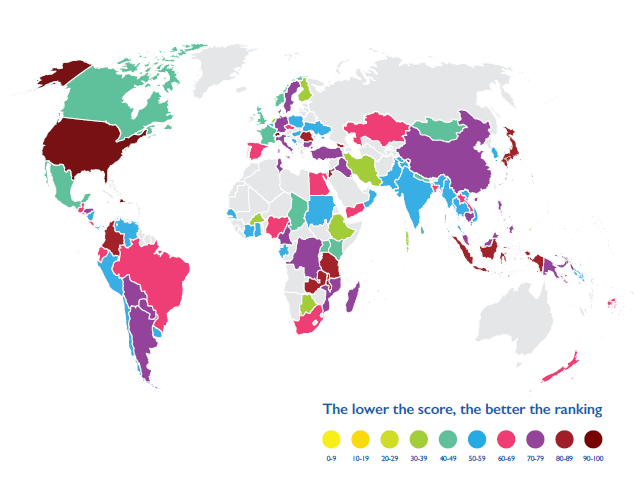
Figure 2: Tobacco industry interference Europe regional ranking [4]
Tobacco industry influence through indirect channels
Although no evidence of unjustified interactions between the tobacco industry itself and government institutions was found in public sources, contacts were identified with sectors that indirectly represent the interests of the tobacco industry. Press shop federations, who, like the tobacco industry, benefit from the sale of tobacco and nicotine products, had multiple contacts with federal ministers in which concerns and needs were expressed. In addition, evidence showed that there are official partnerships between the government and the tobacco industry for the financing and implementation of awareness-raising campaigns on cigarette butt litter. These incidents create an increased risk of influence by the tobacco industry on tobacco control policy and should therefore be avoided.
Limited regulation and lack of transparency
Overall, the report concludes that Belgium has limited formal, preventive measures regulating tobacco industry interference in public health policies. There is currently a ban on sponsorship by the tobacco industry and a general lobbying register for contacts in the Belgian Chamber of Representatives. However, there is no transparency register for contacts with ministers and policymakers. In practice, the tobacco industry is not involved in policymaking, but there are no structural measures or procedures regulating or limiting interactions with ministers and policymakers. Beyond the obligation to notify tobacco and nicotine products, there is also little transparency regarding other activities of the tobacco industry, such as lobbying or corporate social responsibility (CSR) initiatives.
The importance of continuous monitoring
Research shows that interference of the tobacco industry is associated with poorer implementation of evidence-based tobacco policies and higher smoking rates, highlighting the need for government action against such interference [5]. In Belgium, the consumption of tobacco and nicotine products remains a major public health problem. A recent health survey (2023–2024) showed that nearly 18% of the population aged over 15 smokes, with nearly 13% smoking daily [6]. 6.3% uses e-cigarettes, including both daily and occasional use [7]. Data from 2021 indicate that smoking is responsible for 8% of all deaths in Belgium [8]. Related healthcare expenditures represent a substantial societal cost of approximately €534 million per year [9]. In the context of public health, and tobacco control in particular, Sciensano will re-evaluate government measures to limit tobacco industry influence every two years.
3. Read more
Discover the Belgian report on tobacco industry interference index.
References
- World Health Organization. (2003). WHO Framework Convention on Tobacco Control. https://iris.who.int/server/api/core/bitstreams/264104b3-241a-4e48-88f9-aa7120779ffc/content
- Algemene Cel Drugsbeleid. Interfederale strategie 2022–2028 voor een rookvrije generatie. 14 december 2022. https://overlegorganen.gezondheid.belgie.be/sites/default/files/documents/2022_12_14_interfederale_strategie_tabak_en_bijlage_final_nl.pdf
- Assunta, M. Global Tobacco Industry Interference Index 2025. Global Center for Good Governance in Tobacco Control (GGTC). Bangkok, Thailand. Nov 2025.
- Venâncio, R. Europe Tobacco Industry Interference 2025. Smoke Free Partnership. November 2025.
- Lee, Y., Kim, S., Kim, M.K. et al. Association between Tobacco Industry Interference Index (TIII) and MPOWER measures and adult daily smoking prevalence rate in 30 countries. 2024. https://doi.org/10.1186/s12992-023-01003-x
- Gisle, L., en S. Demarest. Health Interview Survey 2023–2024: Tobacco smoking. Brussels, Belgium: Sciensano, 2025. Health determinants | sciensano.be
- Hermans, L., R. Charafeddine, en S. Demarest. Health Interview Survey 2023–2024: E-cigarettes use. Brussels, Belgium: Sciensano, 2025. Health determinants | sciensano.be
- Sciensano. Burden of Disease: Risk Factor Attributable Burden – Burden of Tobacco Use. 2024. Brussel, België. https://www.healthybelgium.be/en/health-status/burden-of-disease/risk-factor-attributable-burden/burden-of-tobacco-use/
- Vynckier, P., M. Schmidt, S. Nayani, L. Guariguata, B. Devleesschauwer, en N. Verhaeghe. “The Economic Burden of Smoking in Belgium: Incremental Healthcare Costs and Lost Productivity.” February 2025. https://doi.org/10.1093/eurpub/ckae211/
Please cite this page as: Sciensano. Factsheets: Belgium’s Tobacco Control Strengthens, but Industry Interference Remains Insufficiently Addressed, Health Status Report, 20 May 2026, Brussels, Belgium, https://www.healthybelgium.be/en/health-status/factsheets/global-tobacco-index